Postpartum Abdominal Laxity: What Can You Do Without Surgery?
A Guide to Non-Surgical Postpartum Abdominal Rejuvenation
Your weight may have returned close to your pre-pregnancy level — so why does your abdomen still look and feel different?
Many mothers notice that even after losing their pregnancy weight, they may still have loose abdominal skin, stubborn fat, wrinkled skin, or uneven skin texture.
The important thing to understand is that a postpartum abdomen is not simply a fat problem, and not every patient requires the same treatment.
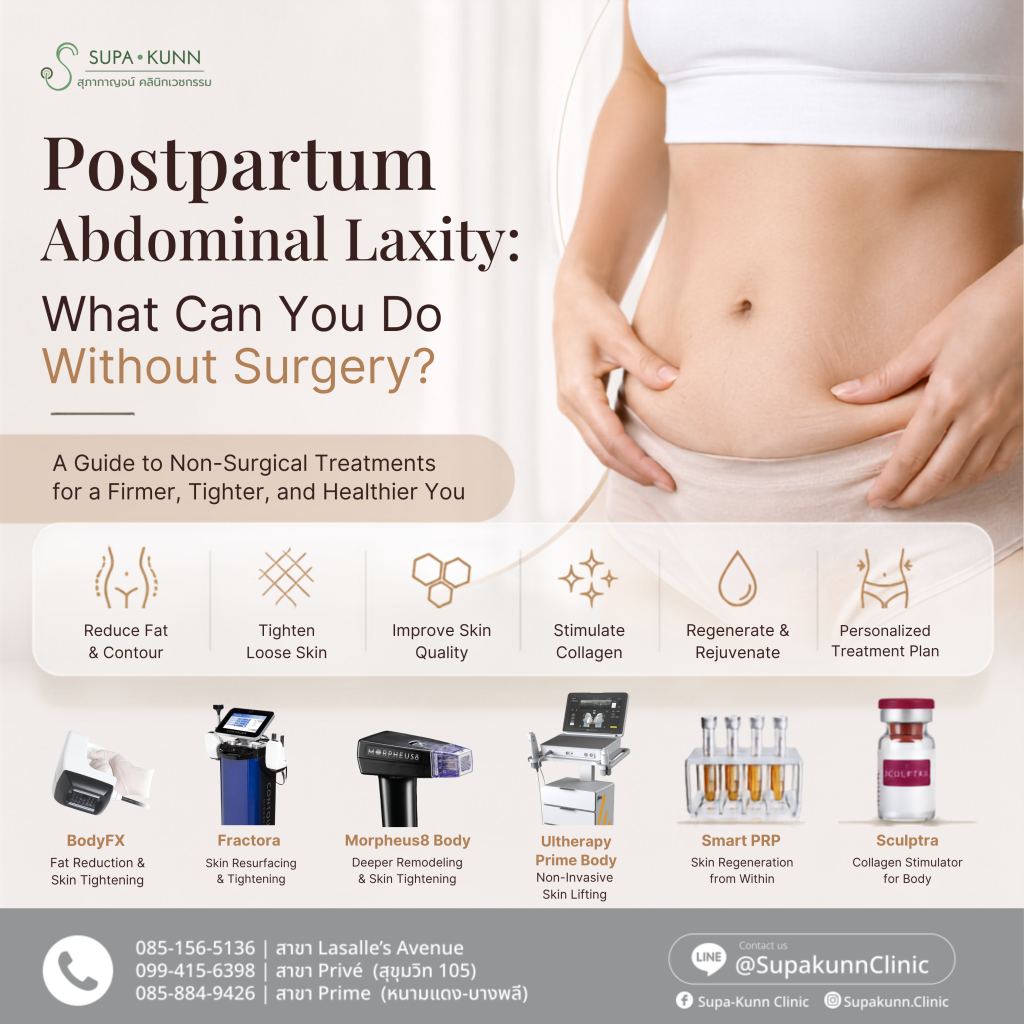
Today, several medical technologies may be considered for non-surgical body contouring and skin rejuvenation, including BodyFX, Fractora, Morpheus8 Body, Microfocused Ultrasound with Visualization (MFU-V), PRP, and Sculptra.
But before choosing a treatment, there is a more important question to answer:
What is actually causing the change in your abdomen?
Why Doesn’t the Abdomen Always Return to Its Pre-Pregnancy Shape?
During pregnancy, the skin and tissues of the abdomen undergo significant expansion to accommodate the growing baby.
After delivery, the body gradually recovers. The initial postpartum recovery period generally takes approximately 6–8 weeks, but some physical changes may continue for several months or longer.
What we commonly call a “postpartum belly” can actually involve several different issues.
1. Subcutaneous Fat
Fat beneath the abdominal skin may remain even after your overall body weight has decreased.
2. Skin Laxity
After being stretched for an extended period, the skin may not completely return to its previous elasticity, resulting in loose or sagging skin.
3. Changes in Skin Quality
Some women may notice thinner skin, wrinkles, uneven texture, or stretch marks following pregnancy.
4. Diastasis Recti
Separation of the abdominal muscles is another important reason why the abdomen may continue to protrude after pregnancy — even when there is relatively little excess fat.
This distinction is particularly important because fat-reduction and skin-tightening treatments do not directly treat diastasis recti.
If significant muscle separation, an unusual abdominal bulge, a possible hernia, or pain is suspected, medical assessment should be performed before considering aesthetic treatment.
What Are the Non-Surgical Options?
There is no single device or procedure that is suitable for every postpartum patient because each technology targets a different problem.
Some treatments primarily target fat.
Others focus on skin laxity.
Some are designed to support skin quality, tissue remodeling, and collagen stimulation.
For this reason, treatment selection should begin with the underlying concern, rather than with the name of a device.
1. BodyFX — When Both Fat and Skin Laxity Are Present
For patients with a soft abdomen, residual subcutaneous fat, and early skin laxity, BodyFX may be one treatment option to consider.
BodyFX combines bipolar radiofrequency (RF) with vacuum-assisted tissue manipulation and controlled electrical pulses.
One of its key characteristics is that the treatment does not focus solely on fat reduction. RF energy also generates controlled heat within the tissue, which is associated with tissue and collagen remodeling.
Clinical studies of BodyFX technology have reported changes in adipose tissue and treatment-area volume. However, outcomes vary between individuals, and some of the available evidence is based on relatively small study populations.
How Is BodyFX Different From CoolSculpting?
Both technologies may be used for non-surgical fat reduction, but they work through very different mechanisms.
CoolSculpting / Cryolipolysis
Cryolipolysis uses controlled cooling to damage targeted fat cells. The body then gradually clears the affected cells over time.
BodyFX
BodyFX combines radiofrequency, vacuum, and electrical pulses, providing both an adipose-tissue treatment component and controlled heating of the surrounding tissue.
Therefore, if the main concern is localized fat, cryolipolysis may be one option.
However, when the concern is:
“I have some excess fat, but my skin is also becoming loose.”
A physician may consider an RF-based technology such as BodyFX, depending on the patient’s anatomy and treatment goals. RF-based technologies also have published evidence regarding skin laxity and cellulite.
Cryolipolysis is also associated with a rare but recognized adverse event called Paradoxical Adipose Hyperplasia (PAH), in which the treated fatty area becomes enlarged rather than reduced.
The potential benefits, limitations, risks, and suitability of either treatment should therefore be assessed individually.
How Many BodyFX Sessions Are Needed?
BodyFX targets both body contouring and controlled thermal effects within the tissue.
Traditional protocols have commonly involved approximately 8–10 sessions, usually performed once a week.
One clinical study evaluated longer treatment sessions performed only 2–3 times and reported volume changes comparable to an eight-session protocol. However, the study population was relatively small, so these findings should not be interpreted to mean that 2–3 sessions can replace a conventional treatment course for every patient.
Most importantly:
BodyFX is not a treatment that should be judged after only one session.
Changes in adipose tissue and surrounding tissues occur gradually.
At SUPA-KUNN Clinic, progress may be monitored through standardized photographs, measurements, and follow-up assessments at appropriate intervals.
2. Fractora — When the Main Concern Is Skin Quality
Some mothers have very little abdominal fat remaining, yet when sitting or bending forward, the skin still appears wrinkled, crepey, or less firm than before pregnancy.
In this situation, further fat reduction may not be the answer.
Fractora is a fractional radiofrequency technology that delivers RF energy into the skin through small microneedles to stimulate tissue repair and remodeling.
The principle involves creating controlled thermal injury at an appropriate depth to stimulate collagen production and restructuring of the skin.
Reviews of RF microneedling have shown that dermal remodeling and neocollagenesis develop gradually and may continue for several months after treatment.
Fractora may therefore be considered when the main concerns include:
- Loose abdominal skin
- Crepey or wrinkled skin
- Uneven skin texture
- Reduced skin quality following pregnancy-related stretching
rather than when fat reduction is the primary goal.
3. Morpheus8 Body — For Skin Laxity and Deeper Tissue Remodeling
Morpheus8 Body also belongs to the radiofrequency microneedling (RF microneedling) category.
The treatment can be designed to deliver energy at different depths depending on the anatomical area and the condition being treated.
RF energy is delivered through microneedles into the tissue, generating controlled heat to stimulate collagen and tissue remodeling.
Research on RF microneedling supports its role in dermal remodeling, neocollagenesis, and skin tightening.
Interestingly, a 2025 clinical study specifically investigated bipolar microneedle RF for postpartum abdominal laxity and reported improvements in abdominal laxity. The authors described the technology as a potentially useful minimally invasive treatment for this concern.
However, this should not be interpreted as evidence that every RF microneedling device will produce identical results.
Devices, energy settings, treatment depth, techniques, and protocols can vary considerably.
This is why treatment design and physician-selected parameters are just as important as the device itself.
How Many Fractora or Morpheus8 Body Sessions Are Needed?
Both technologies use radiofrequency to promote tissue remodeling.
The number of sessions depends on the degree of skin laxity, skin thickness, treatment depth, and parameters selected by the physician.
In clinical practice, approximately 1–3 or more sessions may be considered, with sufficient time between treatments to allow the skin to recover and collagen remodeling to occur.
Morpheus8 is particularly interesting because a prospective study has evaluated RF microneedling in women with postpartum abdominal laxity and reported improvements following treatment.
However:
Finishing the procedure today does not mean that all new collagen will be produced tomorrow.
Results from RF microneedling typically develop gradually over several weeks to months as tissue remodeling progresses.
Follow-up assessment is commonly performed approximately 4–12 weeks after treatment, depending on the protocol and individual response.
4. Ultherapy Prime Body — When There Is Less Fat but Skin Tightening Is the Priority
Some mothers return close to their pre-pregnancy body weight and do not have much excess abdominal fat, but still feel that:
“My skin just isn’t as firm as it used to be.”
Technologies based on Microfocused Ultrasound with Visualization (MFU-V) may be considered for selected body areas.
Focused ultrasound energy is delivered to predetermined tissue depths, creating small thermal coagulation points. This initiates a process involving tissue contraction and subsequent collagen remodeling.
A randomized comparative study has specifically investigated MFU-V for abdominal skin laxity.
Research has also evaluated women with postpartum lower-abdominal skin and soft-tissue laxity, with findings supporting its potential efficacy and safety in appropriately selected patients.
A 2025 consensus publication also described MFU-V as a potential non-invasive option for mild-to-moderate skin and soft-tissue laxity of areas including the abdomen and upper arms.
However, patient selection, individualized treatment design, and realistic expectations are essential.
For patients with substantial amounts of excess skin, non-invasive treatment may not provide results comparable to surgery.
Non-invasive lifting ≠ Tummy Tuck
This difference should be clearly understood before treatment.
Can Ultherapy Prime Body Be Done in a Single Session?
MFU-V differs from treatments that are typically performed as frequent treatment courses.
Several studies have evaluated a single treatment session, followed by assessments approximately 90–180 days later.
This corresponds with the biological mechanism of treatment: the body needs time to produce and reorganize collagen following ultrasound energy delivery.
A simple way to understand the process is:
Treatment → Tissue remodeling begins → Collagen gradually changes → Results are assessed over the following months
Therefore, the final tightening effect should not be expected immediately after treatment.
Instead, each case should be followed to evaluate how the tissue responds over time.
5. Smart PRP — Not for Fat Reduction, but for Skin Regeneration
PRP, or Platelet-Rich Plasma, involves processing a patient’s own blood to obtain a platelet-concentrated component, which is then used according to appropriate indications and medical techniques.
Platelets contain various growth factors and bioactive molecules involved in tissue repair.
Systematic reviews in aesthetic dermatology have reported evidence suggesting that PRP may contribute to skin rejuvenation and may influence collagen density.
However, when we specifically discuss postpartum abdominal laxity, the evidence supporting PRP is currently less robust than that available for certain technologies such as RF microneedling or MFU-V.
PRP is therefore better considered as a treatment focused on skin quality and a regenerative approach, or as part of an appropriately selected combination treatment.
It should not be described as a direct replacement for a skin-tightening or fat-reduction device.
At SUPA-KUNN Clinic, Smart PRP is therefore considered primarily in the context of skin regeneration, rather than as a standalone treatment intended to “lift” the postpartum abdomen.
How Many Smart PRP Sessions Are Needed?
PRP requires particular caution when discussing treatment numbers because there is currently no clearly established standard protocol specifically for postpartum abdominal laxity.
Systematic reviews have found considerable variation in PRP protocols, including preparation methods, platelet concentration, injection techniques, and the number of sessions.
Therefore, current evidence does not allow us to confidently state:
“Postpartum abdominal laxity requires exactly X PRP sessions.”
Current evidence provides some support for PRP in skin rejuvenation, but the certainty and standardization of the evidence remain limited.
For this reason, SUPA-KUNN Clinic considers Smart PRP as part of a skin-regeneration or combination-treatment strategy, rather than prescribing the same fixed number of sessions for every patient.
6. Sculptra — Collagen Stimulation Is Not Limited to the Face
Many people know Sculptra as a collagen biostimulator used for the face.
However, its active ingredient, poly-L-lactic acid (PLLA), has also been studied for aesthetic applications on different areas of the body.
The concept of PLLA is not simply to “fill and tighten” the skin immediately.
Instead, it works by gradually stimulating the body’s own collagen-production process.
Medical literature has described the use of PLLA in non-facial areas including:
- Abdomen
- Upper arms
- Thighs
- Knees
- Buttocks
- Hands
Published evidence suggests potential benefits for skin laxity, wrinkling, cellulite, and overall skin quality.
However, evidence for body applications remains more limited than the evidence available for facial treatment. Recent reviews note that a proportion of the existing evidence still consists of prospective observational studies and case series.
Sculptra should therefore be considered for appropriately selected patients.
It should not be expected to correct significant postpartum excess skin to the same degree as surgical removal.
How Many Sculptra Sessions Are Needed?
Sculptra, or PLLA, differs from conventional filler because its primary purpose is not to provide immediate volume.
It is a collagen biostimulator.
The key concept is:
Results develop gradually.
Reviews of PLLA body applications have described abdominal protocols involving approximately 1–3 sessions, typically separated by several weeks, with reported changes in skin quality, texture, and laxity continuing during follow-up.
A consensus publication on PLLA body applications has also reported abdominal treatment involving 1–2 sessions in small case series, with improvements still observable at 12-month follow-up.
However, the available abdominal data remain limited and should not be used to guarantee the same outcome for every patient.
More broadly, some body-biostimulation approaches use approximately 2–4 sessions at 4–6-week intervals, with results gradually developing and potentially becoming more noticeable over approximately 3–6 months.
Which Treatment Is Right for Your Abdomen?
The most important point is:
Don’t start by asking, “Which machine is the best?”
Start by asking:
“What is the main problem with my abdomen?”
| Main Concern | Treatment a Physician May Consider |
| Localized fat + reduced skin firmness | BodyFX |
| Thin, crepey, wrinkled, or uneven skin | Fractora |
| Skin laxity + deeper tissue remodeling | Morpheus8 Body |
| Minimal fat + mild-to-moderate skin laxity | MFU-V / Ultherapy Prime Body* |
| Skin regeneration | Smart PRP |
| Collagen stimulation + skin-quality improvement | Sculptra / PLLA* |
| Multiple concerns at different tissue levels | Individualized Combination Treatment |
| Significant diastasis recti / hernia / substantial excess skin | Further medical assessment; surgery may be more appropriate |
*The use of each product or technology on specific body areas should be considered according to approved indications in Thailand, manufacturer recommendations, and the treating physician’s clinical judgment.
Why Do Some Patients Need Combination Treatment?
Because pregnancy does not change only one layer of the abdomen.
Think of the abdomen as several different layers:
Fat layer
→ May require body contouring
↓
Skin and soft tissue
→ May require tightening or remodeling
↓
Collagen and skin quality
→ May benefit from regeneration or biostimulation
↓
Abdominal muscles
→ Diastasis recti requires separate assessment
One patient may therefore be suitable for BodyFX alone, while another may benefit from a carefully planned combination such as:
BodyFX → RF Microneedling → Skin Regeneration
or
MFU-V → Collagen Biostimulator
The appropriate approach depends on the underlying concern, fat thickness, degree of laxity, skin quality, treatment goals, budget, and acceptable downtime.
Not everyone needs every treatment.
More treatment does not automatically mean better results.
How Long After Giving Birth Can Treatment Begin?
The postpartum period involves many ongoing physiological changes.
Starting body-contouring treatment immediately after delivery may therefore be unnecessary or inappropriate for some patients.
In general, the body should be allowed to pass through its initial postpartum recovery period before aesthetic treatment is considered.
A physician should also assess factors such as:
- How long it has been since delivery
- Vaginal delivery or Caesarean section
- Whether surgical wounds have healed properly
- Whether body weight has begun to stabilize
- Whether the mother is breastfeeding
- Medical conditions or current medications
- Possible diastasis recti or hernia
- Plans for another pregnancy in the near future
There is therefore no universal answer to:
“How many months after giving birth can everyone start treatment?”
Individual medical assessment before treatment is the most important step.
How Many Sessions Are Needed — and How Long Until You See Results?
Two of the most common questions mothers ask are:
“Will I see results after one session?”
and
“How many sessions will I need before my abdomen becomes firmer?”
The answer depends on both the problem being treated and the technology selected.
Fat reduction and collagen production do not follow the same biological timeline. Most postpartum skin-rejuvenation treatments therefore do not produce their final results immediately.
The treatment numbers below should be understood as approximate ranges based on published studies and commonly described protocols, rather than fixed recommendations for every patient.
| Treatment | Approximate Treatment Course | When Changes May Begin | How Results Develop |
| BodyFX | Multiple sessions; traditional studies have used ~8 weekly sessions | Gradually over several weeks | Better assessed after completing the course and follow-up |
| Fractora | Approximately 1–3 sessions, depending on skin quality and laxity | Several weeks | Collagen remodeling may continue for months |
| Morpheus8 Body | Approximately 1–3 sessions or individualized according to skin laxity | Several weeks | Progressive improvement as collagen remodeling occurs |
| MFU-V / Ultherapy Prime Body* | Several protocols evaluate a single treatment | Approximately 1–3 months | May continue to develop over 3–6 months |
| Smart PRP | No established standard protocol specifically for postpartum abdominal laxity | Gradual | Depends on PRP preparation, combination treatment, and individual response |
| Sculptra / PLLA* | Body studies commonly describe ~1–3 sessions; some approaches use 2–4 | Gradual as collagen production develops | Often becomes more noticeable over approximately 3–6 months |
*Treatment should be considered according to approved indications in Thailand, the specific body area being treated, manufacturer recommendations, and physician assessment.
Why Does One Patient Need One Session While Another Needs Several?
Because “postpartum abdominal laxity” does not mean the same thing in every patient.
Mother A may have significant subcutaneous fat but relatively good skin elasticity.
Mother B may have returned to her pre-pregnancy weight but have thin, crepey, loose skin.
Mother C may have a combination of excess fat, skin laxity, stretch marks, and diastasis recti.
The number of sessions may therefore depend on:
- Degree of skin laxity
- Amount of subcutaneous fat
- Skin quality and thickness
- Age and individual collagen response
- Body weight and weight fluctuations
- Time since delivery
- Pregnancy history
- Selected treatment
- Treatment parameters and technique
- Individual goals
Instead of beginning with:
“How many sessions do I need to buy?”
a more useful question is:
“Which tissue layer is causing my concern, and how much correction am I looking for?”
Once these questions are answered, the physician can design an appropriate treatment plan and estimate a reasonable number of sessions.
When Should Results Be Evaluated?
Just as important as the number of sessions is knowing when to assess the outcome.
Treatments involving collagen remodeling — including RF microneedling, microfocused ultrasound, and collagen biostimulators — require time for the body to respond.
At SUPA-KUNN Clinic, follow-up is therefore not based solely on:
“Does it look tighter immediately after treatment?”
Instead, results should be evaluated systematically across:
Before → During the Treatment Plan → Follow-up
Standardized photographs taken from similar angles and under similar lighting can be combined with assessments of skin laxity, texture, fat thickness, and patient satisfaction.
Effective postpartum abdominal treatment should not be a competition to determine:
“Which machine gives the fastest result?”
The more important questions are:
What is the main problem? → Which treatment addresses it? → How many sessions are appropriate? → Have we allowed enough time for the body to respond?
The SUPA-KUNN Approach: Identify the Layer Before Choosing the Treatment
At SUPA-KUNN Clinic, we do not simply see a larger postpartum abdomen and automatically select a fat-reduction device.
For one patient, the main concern may be fat.
For another, it may be skin laxity.
Another patient may have a combination of fat + skin laxity + changes in skin quality.
And in some patients, what appears to be a persistent postpartum belly may partly result from diastasis recti, which should not be treated simply by reducing fat.
Our approach therefore begins with:
Assess → Identify the Layer → Design the Treatment
The physician can then select the appropriate technology, number of sessions, treatment parameters, and combination strategy according to the individual’s concerns — without assuming that every patient needs every treatment.
The goal of postpartum aesthetic care is not to perform as many treatments as possible in an attempt to make the body look exactly as it did before pregnancy.
The goal is to choose an approach that is appropriate, safe, realistic, and individualized for each mother’s body.
References
- Bai Y, et al. An open single-arm clinical study of microneedle radiofrequency for postpartum abdominal laxity. 2025.
- Vachiramon V, et al. Efficacy and Safety of Microfocused Ultrasound With Visualization in Abdominal Skin Laxity: A Randomized, Comparative Study. Lasers Surg Med. 2020.
- Lin FG, et al. Nonsurgical Treatment of Postpartum Lower Abdominal Skin and Soft-Tissue Laxity Using Microfocused Ultrasound With Visualization. 2020.
- Dayan E, et al. A Minimally Invasive Combination Treatment for Skin Laxity of the Face and Neck. Aesthetic Surgery Journal. 2019.
- Tan MG, et al. Radiofrequency Microneedling: A Comprehensive and Critical Review. Dermatol Surg. 2021.
- Duncan DI. A prospective study analyzing the application of radiofrequency energy and high-voltage, ultrashort pulse duration electrical fields on the quantitative reduction of adipose tissue. 2016.
- Stein MJ, et al. Paradoxical Adipose Hyperplasia Following Cryolipolysis. 2024.
- Asubiaro J, et al. Platelet-Rich Plasma in Aesthetic Dermatology. 2024.
- Haddad A, et al. Injectable Poly-L-Lactic Acid for Body Aesthetic Treatments. 2024–2025.
- Christen MO. Collagen Stimulators in Body Applications: A Review Focused on Poly-L-Lactic Acid (PLLA). 2022.
Medical Disclaimer: Treatment outcomes vary between individuals. All procedures should be selected following an appropriate medical assessment. This article is intended for educational purposes only and does not replace individualized medical diagnosis or professional medical advice.
👩🏻⚕️ที่สุภากาญจน์คลินิก...เราใส่ใจ ให้คุณมากกว่าได้มากกว่าที่ไหน 👩🏻⚕️ 1 ใน 10 ที่ได้รับเลือกเป็นคลินิกสวย มั่นใจ ปลอดภัย คลินิกคุณภาพ จากสำนักข่าวชั้นนำ #ได้ดูแลผิวอย่างมั่นใจ ✅ดูแลคุณโดยคุณหมอที่เชี่ยวชาญ จบด้านผิวหนังโดยตรง ✅ดูแลคุณด้วยทีมที่มีประสบการณ์หลายสิบปี ✅ดูแลคุณ ภายใต้มาตรฐาน ความสะอาด ปลอดภัย สูงสุด #ได้ดูแลผิวอย่างสบายใจ ✅ดูแลคุณ ตรงจุด ตรงโจทย์ปัญหาผิว ✅ดูแลคุณ ด้วยตัวยาแท้ เครื่องมาตรฐานสูงสุด US FDA มั่นใจในความเปลี่ยนแปลง เห็นผล ✅ไม่มีเซลล์หน้าร้าน และ ไม่มีการขายคอร์ส ✅ให้คุณมั่นใจว่า คุณหมอแนะนำการรักษาที่เหมาะสมกับคุณจริงๆ 🎀 **** สนใจสอบถาม นัดคิว ได้ที่ **** https://linktr.ee/SupakunnClinic สุภากาญจน์ คลินิก ลาซาล-แบริ่ง โทร : 0851565136 Line : @SupakunnClinic Instagram : Supakunn.clinic Tiktok : Supakunn.clinic
📍 Privé Sukhumvit 105 | 099-415-6398 📍 Prime Namdang–Bangplee | 085-884-9426
Copyright © SUPA-KUNN CLINIC. All rights reserved. Unauthorized use and/or duplication of this material without express and written permission from this site’s author and/or owner is strictly prohibited. Excerpts and links may be used, provided that full and clear credit is given to SUPA-KUNN CLINIC with appropriate and specific direction to the original content.
Share: