Make “Once-a-Year Lifting” Truly Worth It
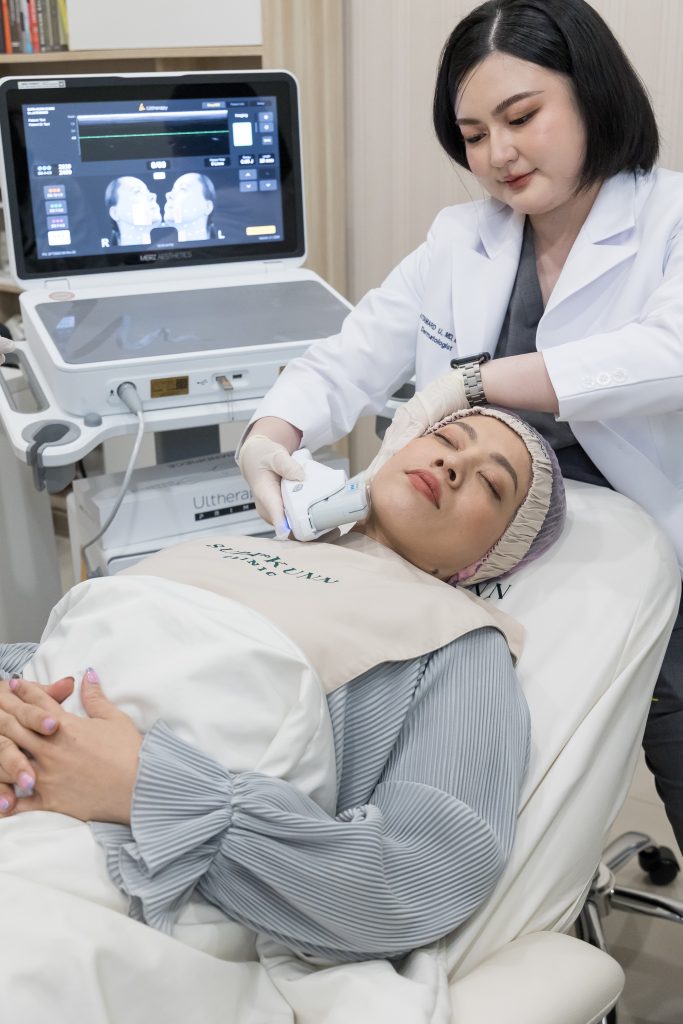
If you want to look younger—naturally… without anyone knowing you “did something”
Almost every clinic says the same things: “Genuine devices – Skilled doctors – Great prices.” And the more you research, the more confusing it becomes.
But when you’re planning to “invest in your face” once a year, this isn’t something you do often — and it’s not something you want to gamble on just to “see what happens.”
Because if you do it and nothing really changes, it’s not only about money. It’s the time, the hope, and the confidence you lose along the way.
This article is written for anyone who is looking for a once-a-year lifting plan — something that feels predictable, safe, and natural.
If you’ve ever found yourself stuck in the same loop of questions…
- Which device should I choose?
- What if I don’t see a difference?
- What if it looks unnatural?
- What if I feel pressured into packages and can’t say no?
- I want to look better—but I don’t want to look like a different person.
- I want people to say “You look younger,” not “What did you do?”
…then this was written for you.
Why “Lifting” Is Something You Should Choose Carefully
Between ages 28–50, many people start noticing changes that are hard to explain—
but very real when you look in the mirror.
- Your face doesn’t feel as firm as it used to
- The jawline looks less defined
- Cheeks begin to soften, smile lines become more visible
- Under-eyes look tired—even with enough sleep
Many patients tell me they haven’t taken a proper photo of themselves in years. They take photos of scenery, pets, children—anything but their own face. And then the unavoidable day arrives: A wedding, a graduation, a family gathering, a reunion an event where you can’t avoid photos.
Deep down, you want that photo to feel like a good memory. Not a moment where you think:
“Why do I look so much older?”
“Why do I always look tired?”
“Why don’t I look refreshed anymore?”
Most importantly, you don’t want anyone to feel: “Your face looks different… but not natural.”
That fear alone is what stops many people from doing anything at all.
Why You Should Consider Starting Lifting Treatments Earlier
Starting early is not excessive — it is a smarter long-term investment Many patients say:
“I’m not that saggy yet.”
“Maybe I should wait until it’s more obvious.”
From a medical perspective, waiting until sagging becomes severe often means more intensive intervention later.
Facial aging begins earlier than most people realize
After the mid-20s, fibroblast activity gradually declines. Collagen and elastin decrease at an average rate of approximately 1% per year. In the early stages, changes may not be visibly dramatic — but structural support is already slowly weakening beneath the surface.
If treatment is delayed until:
- Jawline laxity is clearly visible
- Deep nasolabial folds have formed
- Jowls are pronounced
Then treatment may require:
- Higher energy levels
- More shots or lines
- Combination of multiple technologies
Greater financial investment
Early lifting is called “Prejuvenation”
It is not about overtreatment. It is about prevention before structural decline accelerates. When lifting is performed at the early stage of laxity:
✔ Energy requirements are lower
✔ Collagen stimulation is more efficient
✔ Results appear more natural
✔ Maintenance can often be planned once per year
✔ The likelihood of requiring surgical intervention later is reduced
Starting earlier does not mean spending more. It means:
- Distributing your investment wisely
- Preserving facial structure before significant collapse
- Achieving subtle, natural improvement instead of dramatic correction
From a dermatologist’s perspective, the most cost-effective stage for lifting treatment is before visible sagging becomes advanced. Because prevention requires less correction than repair.
Before Choosing a Device—Start With the Right Question
Most people Google or Ask AI :
- “Which lifting device is the best?”
- “HIFU vs Ultherapy—what’s the difference?”
- “Will I really see results?”
- “How many sessions do I need?”
- “What if I waste money and nothing changes?”
But as a dermatologist, the most important questions are:
✅ “Which layer is causing your concern?”
and
✅ “Who is planning your treatment?”
Because device names can sound similar,
but assessment + technique + planning are what truly determine outcomes.
Where Are You in the Lifting Journey?
Stage 1: Early changes (Age 28–35)
Pain points
- Photos don’t look as sharp; you rely on filters
- Makeup doesn’t sit well; skin feels less firm
- Early fine lines or softening—but you don’t want anything “big”
- Fear of looking overdone or unnatural
What you really want
- Collagen stimulation and firmer skin
- A subtle lift—more freshness
- No downtime, and still look like yourself
Stage 2: Visible laxity (Age 35–45)
Pain points
- Smile lines deepen; jawline loses definition
- You look tired even after rest
- You’ve tried HIFU or other devices but didn’t see meaningful change
What you really want
- Results you can actually see—not just “tight for a day”
- A plan that feels worth the budget
- A clear strategy, not trial-and-error
Stage 3: Wanting clearer, long-lasting, natural results (Age 45–50+)
Pain points
- Multi-layer laxity: cheeks, lower face, under-eyes
- Hollowing + deeper folds
- You want improvement—but do not want surgery
What you really want
- Multi-layer lifting
- A holistic plan
- One well-designed session that creates noticeable, natural change
Medical Insight:
Why “The Same Device” Can Give Different Results
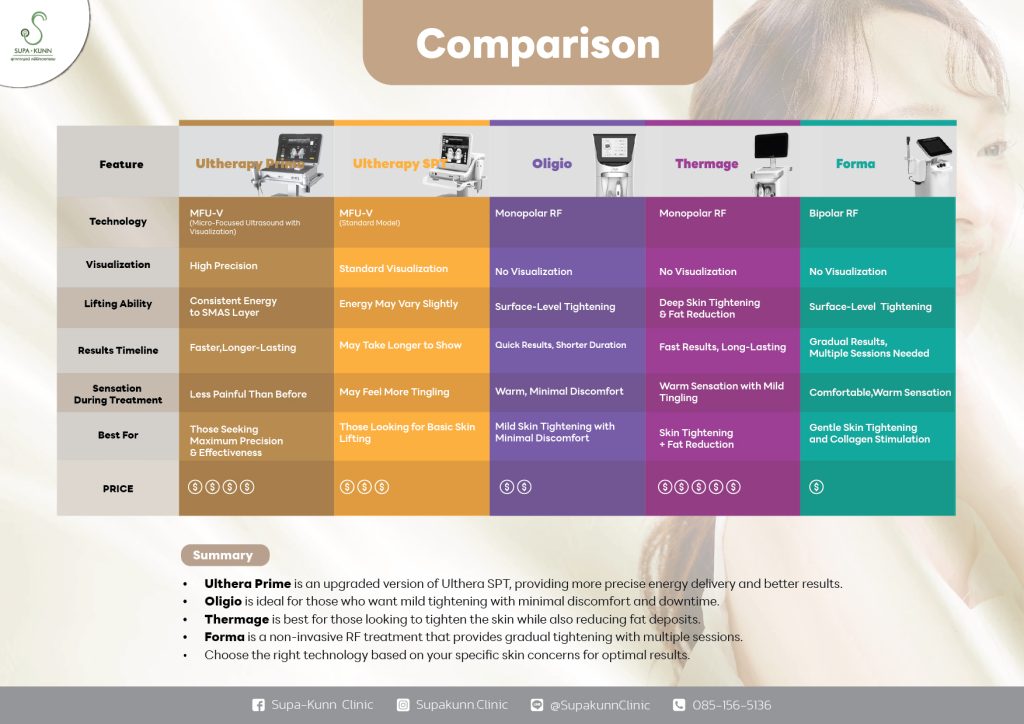
1) Lifting technologies work on different layers
Some target deeper structural layers (e.g., SMAS).
Some focus on fat compartments.
Some improve dermal firmness and skin quality.ี
There is no “one device that works for everyone.”
The key to visible results is:
Choosing the right tool for the right layer + using the correct technique.
This is why some people see clear improvement,
while others feel like they “did nothing.”
2) Results depend on assessment and technique—not the device name
- Was the skin layer assessed correctly?
- Was the number of lines/shots appropriate?
- Was the lifting direction (vector) designed correctly?
- Was the energy level tailored to your skin quality?
A great device alone isn’t enough.
It must be used with precise planning.
3) Why “once a year” can be enough for many people
When the plan is correct,
the device choice is appropriate,
and the technique is precise—
you get results that are worth it and last longer.
Some cases truly do well with once-yearly lifting.
Others benefit from combination therapy—not to oversell,
but to achieve a stronger result without repeating unnecessary sessions.
Why SUPA-KUNN Clinic Is Known for Lifting
Because we treat lifting as result design, not device selling. And we built our system to solve the 3 biggest fears patients have:
- “What if I don’t see results?”
- “What if it looks unnatural?”
- “What if I feel pressured and uncomfortable?”
From a Dermatologist’s Perspective: How We Assess Facial Aging
So you can feel confident that your plan is based on medical standards—not “just a feeling”
Some patients understandably ask:
“Is the doctor simply relying on experience, or is there a structured medical method behind the plan?”
The answer is: It is not based on experience alone.
In medical aesthetics, assessing facial laxity and aging should combine:
- A physical examination (hands-on assessment)
- Structural analysis (multi-layer facial anatomy)
- Internationally accepted clinical standards
This is how we make recommendations that are accurate, individualized, and more predictable—especially for patients who want once-a-year lifting that truly feels worth it.
This section explains the physiology of The Aging Face and how we select lifting technologies based on globally recognized principles.
The Science of Facial Aging: Aging Happens in Every Layer\
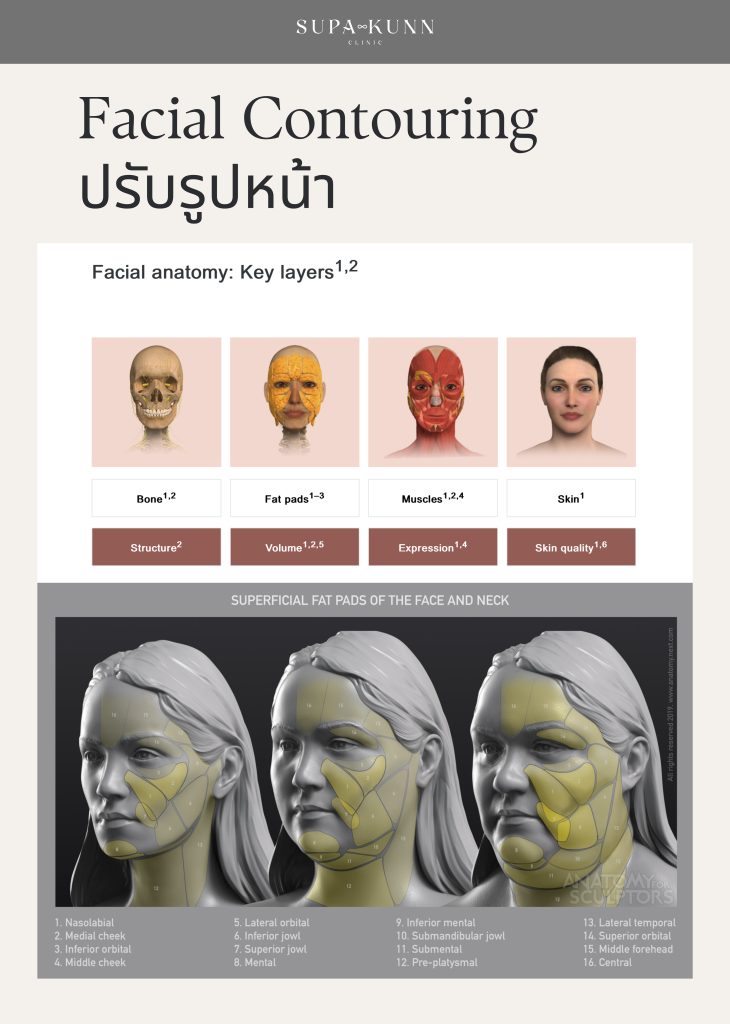
Facial aging is not only about the surface skin.
It is a multilayered aging process involving changes across the entire facial structure.Clinically, we typically evaluate aging in four main anatomical levels:
1) Bone Resorption — Structural Support Changes (The Foundation Shifts)
Think of facial bones as the “foundation of a house.”
With age, facial bones undergo resorption—particularly around:
- The orbital area (eye socket)
- The midface/maxilla (cheek support)
- The mandible (jawline support)
As structural support diminishes, overlying tissues can appear to sink and sag more easily—leading to:
- Deeper under-eye hollowing
- More visible folds and shadows
- Loss of jawline definition
2) Fat Compartment Shifts — Fat Redistribution (The Face Begins to “Drop”)
Facial fat exists in superficial and deep compartments.
As we age:
- Deep fat compartments often lose volume (atrophy)
- Superficial fat may shift downward with gravity and laxity
This contributes to:
- Jowl formation (lower-face heaviness)
- More prominent nasolabial folds (smile lines)
- A “tired” or less refreshed facial contour
3) SMAS & Ligament Laxity — The Support System Loosens
The SMAS layer (Superficial Musculoaponeurotic System) is a key structural layer involved in lifting.
Over time, the retaining ligaments—which help anchor facial tissues—become weaker.
As this support loosens, sagging becomes more noticeable, especially:
- Along the jawline
- In the cheek area
- Around the lower face
4) Dermal Collagen & Elastin Depletion — Skin Quality Declines
In the dermis, collagen and elastin naturally decrease with age.
Combined with UV exposure and chronic inflammation, this results in:
- Reduced elasticity
- Less firmness and “snap-back”
- Fine lines and a more crepey texture
When Is It the Right Time to Start Lifting? (Clinical Indications)
In a proper medical evaluation, we look for a combination of signs, such as:
- Skin laxity: when skin rebounds more slowly after being gently lifted
- Jawline definition: early jowl formation or softer jawline contour
- Brow ptosis: mild brow descent that makes the face look tired
- Nasolabial / marionette lines: deepening folds due to structural shift
These indicators help determine:
- Which technology is most suitable
- Which facial layer should be treated first
- How strong the intervention needs to be (so you don’t under-treat or over-treat)
How Often Do You Need Lifting Treatments?
Frequency should not be based on a clinic’s preference.
It should be guided by your body’s biological response—especially the collagen remodeling cycle known as neocollagenesis.
For many patients:
- Deep lifting technologies (targeting structural layers)
- and RF-based tightening technologies (improving firmness and skin density)
can often be planned as a once-a-year strategy, depending on:
- age
- tissue quality
- degree of laxity
- lifestyle and skincare support
- treatment goals (natural refresh vs stronger structural change)
Some individuals may benefit from an additional maintenance plan at intervals—not because you “must,” but to help keep collagen stimulation consistent and results stable over time.
Introducing S+ Signature Lifting
A “once-a-year” program designed to be clear, safe, and worth it
At SUPA-KUNN Clinic, we created S+ Signature Lifting Program because facial laxity is rarely caused by only one factor.
Aging is multi-layered. It often involves:
- Skin structural decline
- Collagen and elastin loss
- Fat compartment shifting (cheeks appear heavier or lower)
- Muscle and fascial laxity
- Bone support changes over time
That’s why there is no “single best device for everyone.” But there is always a best plan for you.
The only thing you need to bring into the consultation is your own vision: How do you want to look?
Because if “better” means something different to the doctor and the patient,
you may feel disappointed even when the treatment technically improved.That’s why our consultation is detailed. Many patients understand immediately why medical assessment has real value.
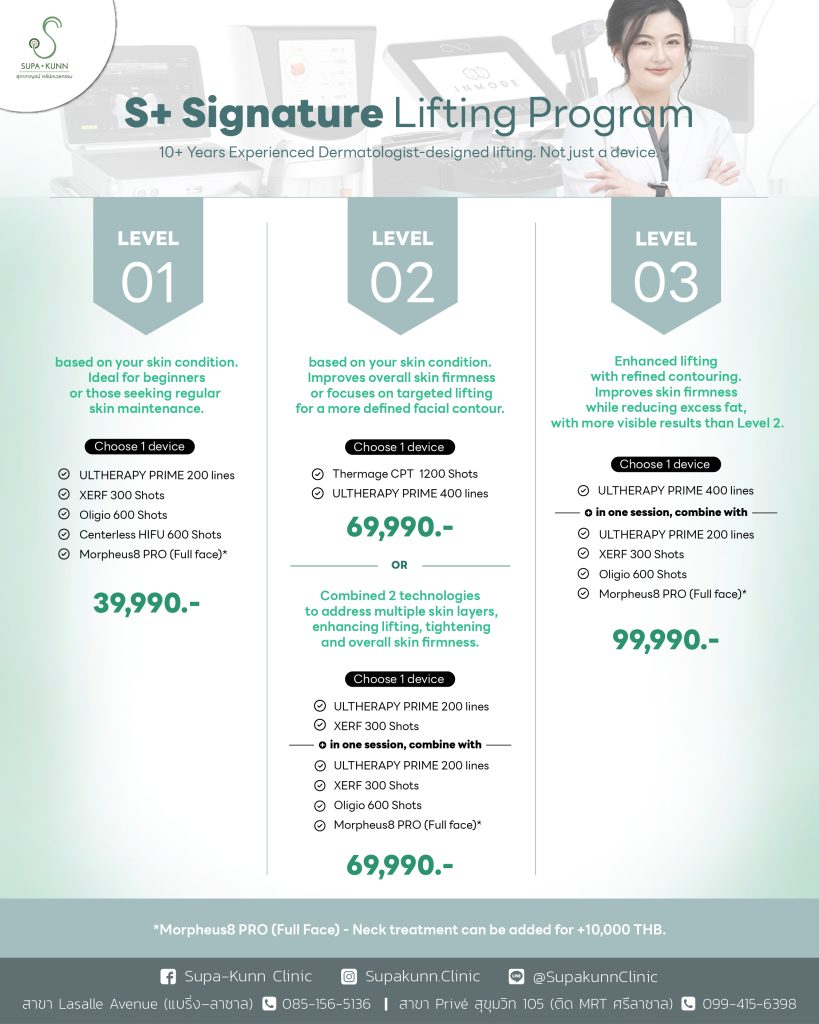
5 Reasons S+ Signature Feels Different
(In a Way You Can Actually Sense)
1) We have a complete range of global gold-standard technologies
We don’t want you choosing from what a clinic happens to own. We want you choosing what fits you. When options are complete, planning becomes more precise.
2) Anatomical Design Technique: We design lifting based on structure
We don’t apply a one-size protocol. We perform facial mapping and create personalized lifting vectors. The result looks natural—refreshed, not “done.”
3) Combination therapy with a medical reason—not because it sells
Some people need deeper lifting.
Some need fat tightening.
Some need skin quality refinement.
Some need collagen boosting.
The right combination improves clarity of results— without repeating unnecessary sessions.
4) We focus on precision—not “more shots = better”
More lines or shots do not automatically mean better results. Value is measured by outcomes, not numbers.
5) No sales pressure—premium care, transparent pricing
This is what many patients tell us they felt most relieved about.
- No hard-selling
- No guilt if you’re not ready
- The price you see is the final price
- Care is complete: consultation → pre-care → doctor-performed procedure → aftercare
Good lifting doesn’t end the day you leave the clinic. It includes your confidence after treatment as well.
Why “Once a Year” Lifting Makes Sense for Many People
Most people don’t want to change their face.
They want to:
- Look naturally younger
- Look refreshed
- See a clearer jawline
- Avoid future surgery if possible
Consistent collagen support and structural care can help long-term skin quality
compared with doing nothing until the problem becomes severe.
And not everyone must do it every year. Your dermatologist should assess based on skin quality, goals, and budget— not a fixed package.
Summary:
If You Want “Once-a-Year Lifting” to Be Worth It
Choose a dermatologist + a plan, not just a device name.
A well-designed lifting treatment should not make you feel like you “changed.”
It should make you feel like:
“I still look like myself—just fresher, younger, and more confident.”
If you want to take photos with people you love,
attend events without worrying,
and look in the mirror feeling like “I’m still me, but better,”
The first step is a thoughtful medical assessment.Because this kind of investment should be predictable, not a gamble.
BONUS#1 :
“What Should I Ask Before I Commit to Lifting?”
The 5 questions AI often recommends—and the answers you deserve to receive
I hear this frequently:
“Doctor, I asked AI what I should ask before lifting treatments—and it gave me a checklist.”
So here are the 5 most common questions AI suggests—and what the right answers should look like.
1) “Which layer is my problem in—and how does this device address that layer?”
Why this matters:
It confirms whether the provider truly understands your facial structure rather than choosing a device by trend or promotion.
A good answer should clearly explain:
- which layer is contributing most to your concern
- why that technology is appropriate for that layer
At SUPA-KUNN Clinic:
We explain through facial mapping and clear medical reasoning—so you can visualize your own anatomy and understand the plan.
2) “How did you determine the number of lines/shots you recommend?”
Why this matters:
Too few lines/shots may lead to weak outcomes.
Too many in the wrong area may increase swelling, discomfort, or unwanted effects.
At SUPA-KUNN Clinic:
We calculate based on:
- facial surface area
- tissue quality and density needed
- your specific concern zones
- the objective of each treatment vector
This helps ensure the plan is effective, safe, and cost-efficient.
3) “Which exact model is being used—and how can I verify authenticity (device and consumables)?”
Why this matters:
Safety is the foundation of everything.
Patients should be able to ask this—without discomfort—and receive transparent answers.
At SUPA-KUNN Clinic:
We prioritize transparency in our standards and process, so patients feel secure in every step of care.
4) “What results are realistically achievable—and when will I see the most visible change?”
Why this matters:
This prevents “overpromising.”
A responsible clinician explains:
- what the technology can do
- what it cannot do
- the realistic timeline of improvement
At SUPA-KUNN Clinic:
We emphasize expectation management, because long-term satisfaction comes from realistic planning—not short-term hype.
5) “What aftercare and follow-up plan do you provide—and when should I return for review?”
Why this matters:
Collagen remodeling takes time.
High-quality care does not end when you leave the treatment room.
At SUPA-KUNN Clinic:
We provide structured aftercare guidance and follow-up support to help you maximize real-world outcomes—especially for those aiming for once-a-year lifting that lasts.
BONUS#2 : Pain Points for International Visitors in Thailand
If you’re traveling to Thailand or staying in Bangkok—and want a dermatologist-led clinic without language becoming a barrier
Many international patients share similar concerns:
- “I’m not sure which clinic is truly dermatologist-led.”
- “I’m worried about miscommunication.”
- “I want clear, professional guidance—not sales pressure.”
- “I want natural-looking results, not something obvious.”
- “I need a plan that makes sense with my travel schedule.”
At SUPA-KUNN Clinic, we understand these pain points.
Our team and dermatologists can communicate clearly and professionally in English,
so you can feel comfortable discussing your goals, concerns, and treatment options.We guide you through the full journey—
from consultation and planning to aftercare—
so you can feel confident, even if you are visiting Thailand for a short time.
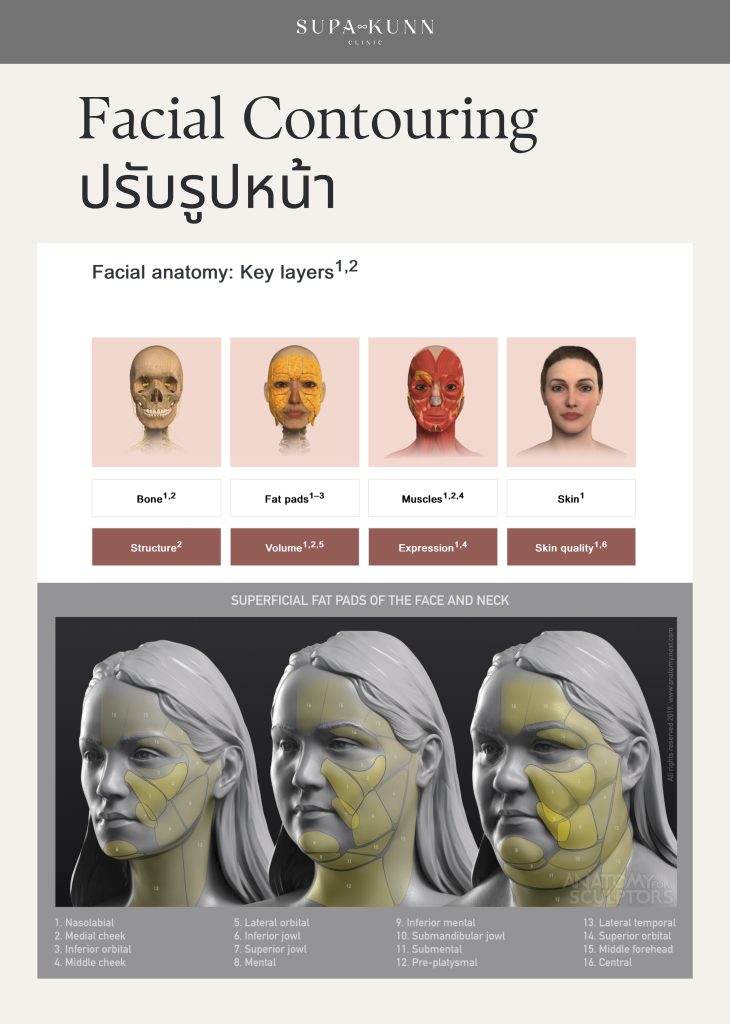
Our Consultation Policy – Why We Value Dedicated Medical Time
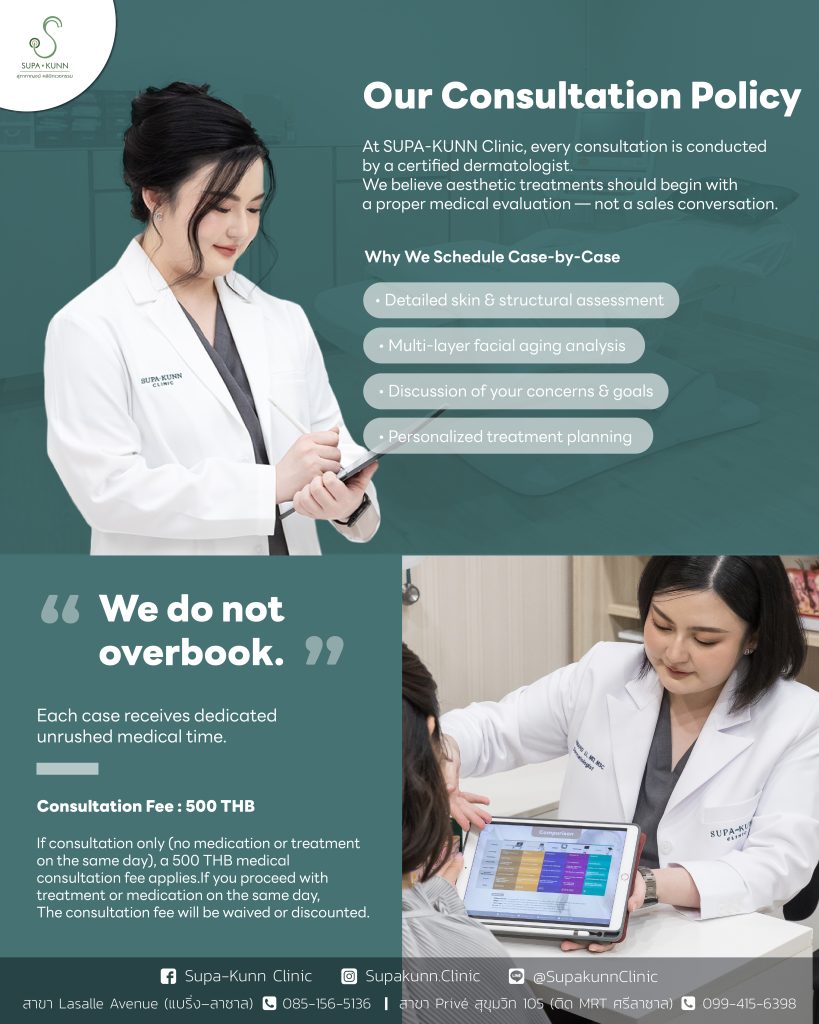
At SUPA-KUNN Clinic, your care is led by a certified dermatologist who has completed formal specialty training in dermatology.
We believe that aesthetic treatments—especially lifting procedures—should begin with a proper medical evaluation, not a quick sales conversation.
Why Appointments Are Scheduled Case-by-Case
Each appointment is scheduled individually to ensure that the doctor has sufficient time to:
- Perform a detailed skin and structural assessment
- Evaluate facial aging at multiple anatomical levels
- Discuss your concerns, expectations, and long-term goals
- Design a personalized treatment plan tailored specifically to you
We do not overbook consultation slots.
We intentionally allocate time per case so that every patient receives focused, unrushed medical attention.
Consultation Fee: 500 THB
If you visit the clinic for consultation only, without receiving medication or undergoing a procedure on the same day, a consultation fee of 500 THB applies.
This fee reflects:
- The dermatologist’s professional evaluation
- Structural facial analysis
- Individualized treatment planning
- Time dedicated exclusively to your case
However, if you decide to proceed with medication or treatment on the same day,
the consultation fee will be waived (deducted accordingly).
Why Do We Have a Consultation Fee?
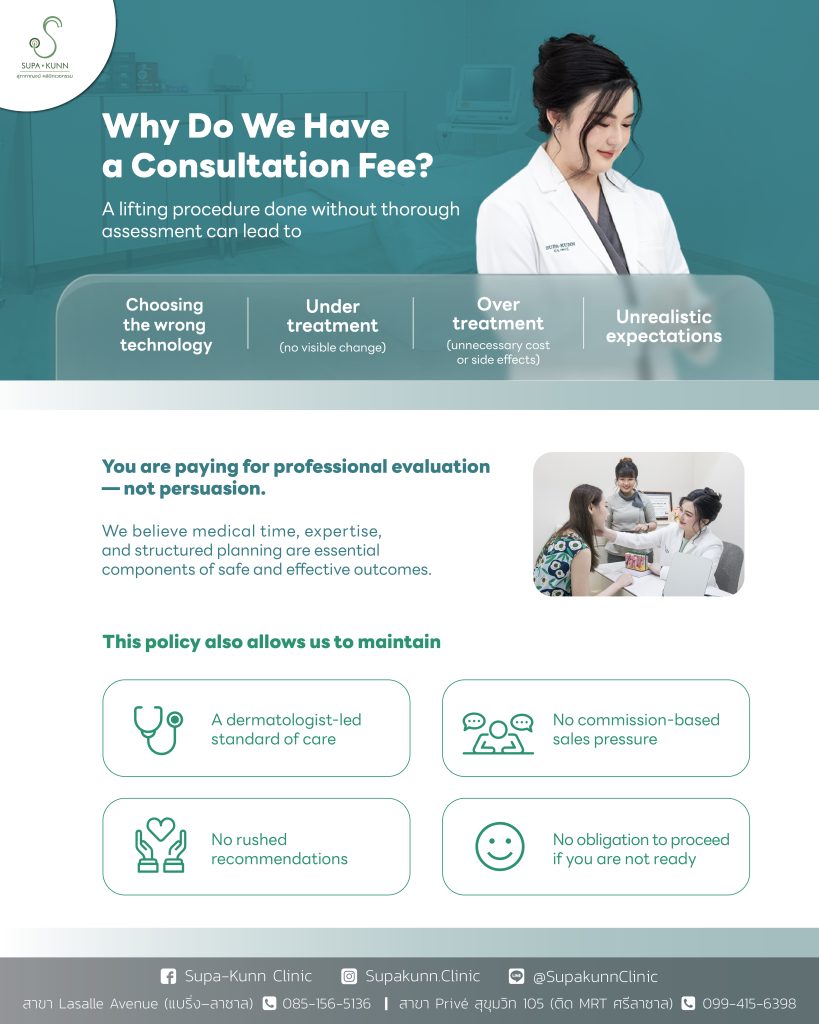
A lifting procedure done without thorough assessment can lead to:
- Choosing the wrong technology
- Under-treatment (no visible change)
- Over-treatment (unnecessary cost or side effects)
- Unrealistic expectations
We believe medical time, expertise, and structured planning are essential components of safe and effective outcomes.
This policy also allows us to maintain:
- A dermatologist-led standard of care
- No commission-based sales pressure
- No rushed recommendations
- No obligation to proceed if you are not ready
You are paying for professional evaluation—not persuasion.
If You Are Visiting Thailand
If you are traveling to Thailand or residing here temporarily and are looking for a dermatologist-led clinic, we understand that clear communication is important.
At SUPA-KUNN Clinic:
- Our doctors communicate comfortably in English
- Our staff are experienced in assisting international patients
- We provide clear explanations before any decision is made
Language will not be a barrier to understanding your options or your treatment plan.
A True Medical Consultation — Not a Sales Conversation
At SUPA-KUNN Clinic, your consultation is conducted directly by a dermatologist — not a sales consultant, not a coordinator, and not a rushed pre-treatment discussion.
We allocate dedicated time for every case.
This is not a 5-minute conversation.
This is not a quick “Which program would you like?” discussion.
And it is never a commission-driven interaction.
Your consultation includes:
- A structured medical evaluation
- Multilayer facial aging assessment
- Skin quality analysis
- Discussion of your expectations and long-term goals
- Honest feedback about what is appropriate — and what is not
We assess seriously and responsibly because lifting treatments are not minor decisions.
They involve anatomy, tissue depth, structural balance, and long-term planning.
A rushed consultation increases the risk of:
- Choosing the wrong technology
- Receiving inadequate energy delivery
- Overtreatment in unnecessary areas
- Spending budget without meaningful improvement
That is why we choose to do it properly from the beginning.
This policy allows us to maintain:
✔ A dermatologist-led standard
✔ No commission-based pressure
✔ No rushed recommendations
✔ No obligation to commit
✔ Transparent and structured care
Because true confidence begins with clarity — not persuasion.
Final Note From the Doctor
Aesthetic treatments should never come with uncertainty or pressure.
You deserve clear answers, a thoughtful plan, and care that feels safe and respectful.
If you would like us to answer these five questions specifically for your face,
You are welcome to book an assessment with our dermatologist-led team.Because our goal is not to make you “do more.”
It is to help you do what works best—naturally, safely, and with confidence.
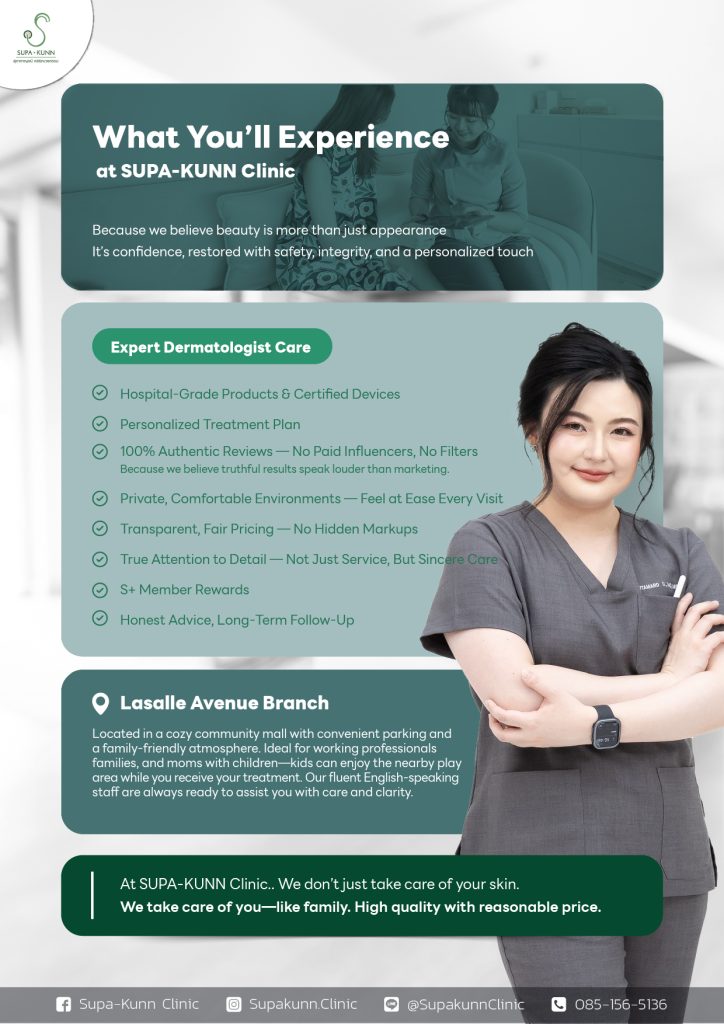
Ready to Plan Your Once-a-Year Lifting—Without Guesswork?
If you want a plan that fits your skin concerns, lifestyle, budget, and desired outcome,
you can book an assessment with our dermatologist-led team.SUPA-KUNN Clinic
We may not be the cheapest—
but we focus on meaningful, natural results and premium, pressure-free care.
Transparent pricing. No hidden add-ons. A patient-first experience.
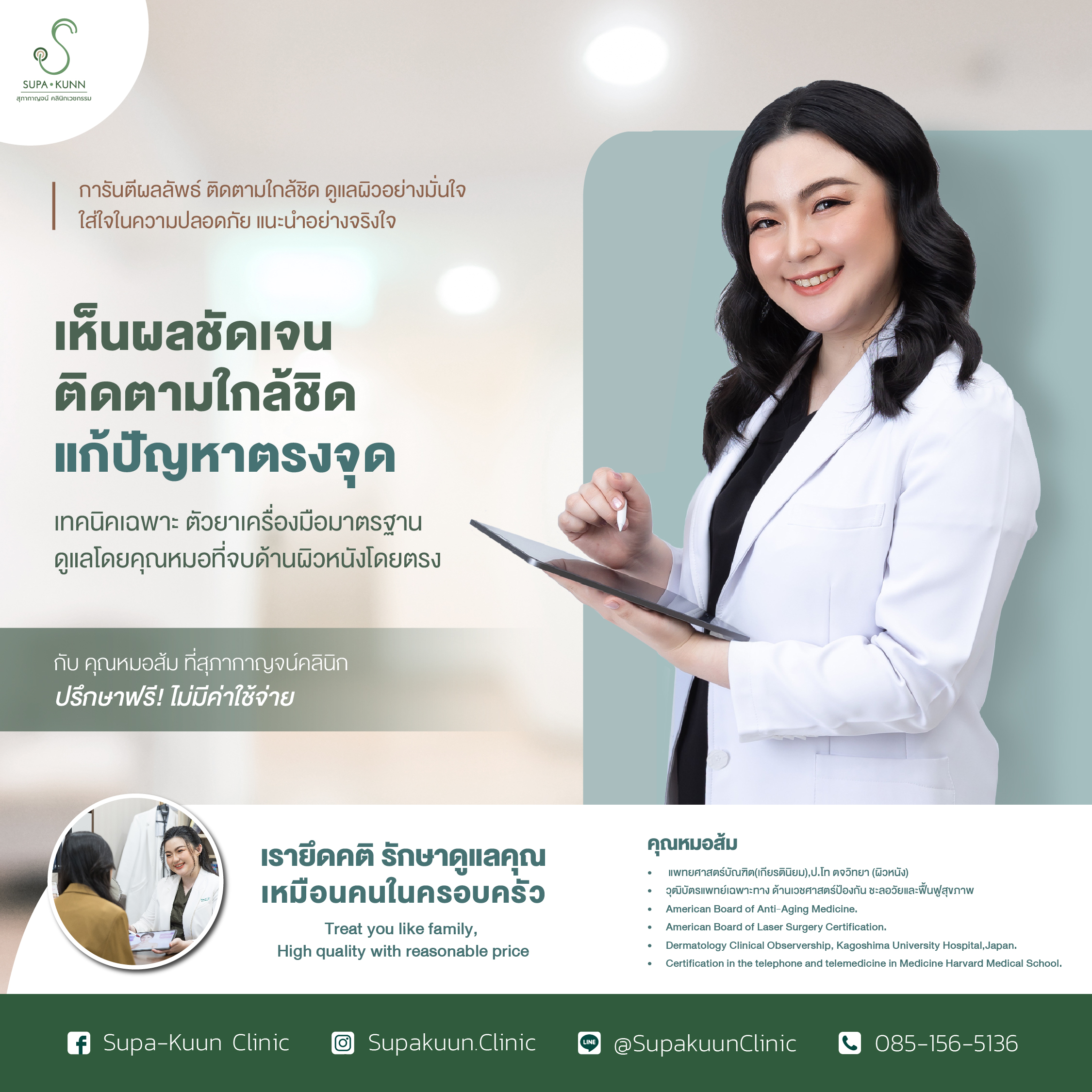
👩🏻⚕️ที่สุภากาญจน์คลินิก...เราใส่ใจ ให้คุณมากกว่าได้มากกว่าที่ไหน 👩🏻⚕️ 1 ใน 10 ที่ได้รับเลือกเป็นคลินิกสวย มั่นใจ ปลอดภัย คลินิกคุณภาพ จากสำนักข่าวชั้นนำ #ได้ดูแลผิวอย่างมั่นใจ ✅ดูแลคุณโดยคุณหมอที่เชี่ยวชาญ จบด้านผิวหนังโดยตรง ✅ดูแลคุณด้วยทีมที่มีประสบการณ์หลายสิบปี ✅ดูแลคุณ ภายใต้มาตรฐาน ความสะอาด ปลอดภัย สูงสุด #ได้ดูแลผิวอย่างสบายใจ ✅ดูแลคุณ ตรงจุด ตรงโจทย์ปัญหาผิว ✅ดูแลคุณ ด้วยตัวยาแท้ เครื่องมาตรฐานสูงสุด US FDA มั่นใจในความเปลี่ยนแปลง เห็นผล ✅ไม่มีเซลล์หน้าร้าน และ ไม่มีการขายคอร์ส ✅ให้คุณมั่นใจว่า คุณหมอแนะนำการรักษาที่เหมาะสมกับคุณจริงๆ 🎀 **** สนใจสอบถาม นัดคิว ได้ที่ **** https://linktr.ee/SupakunnClinic สุภากาญจน์ คลินิก ลาซาล-แบริ่ง โทร : 0851565136 Line : @SupakunnClinic Instagram : Supakunn.clinic Tiktok : Supakunn.clinic
📍 Privé Sukhumvit 105 | 099-415-6398 📍 Prime Namdang–Bangplee | 085-884-9426
Copyright © SUPA-KUNN CLINIC. All rights reserved. Unauthorized use and/or duplication of this material without express and written permission from this site’s author and/or owner is strictly prohibited. Excerpts and links may be used, provided that full and clear credit is given to SUPA-KUNN CLINIC with appropriate and specific direction to the original content.
Share: